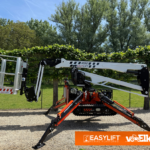
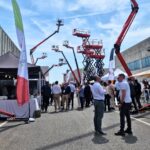
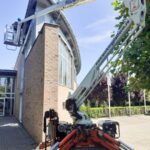
At Easy Lift, our approach to innovation always stems from concrete needs. Behind every new model and every restyling of our range of tracked aerial platforms is a desire to respond effectively to market demands. This commitment takes shape through our “ Simple Inside” philosophy, the vision that has always guided the company and which prioritizes ease of use and simplified maintenance.
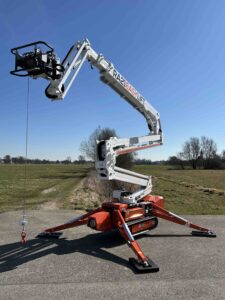
The approach to innovation
The development of new Easy Lift tracked platform models starts with a careful analysis of the real needs of the market. Internal studies, aimed at identifying which solutions can make a difference, are complemented by feedback from dealers who report the operational needs of end customers and rental companies.
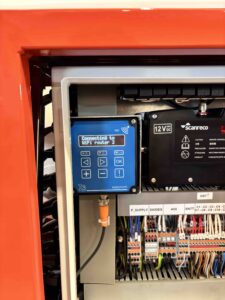
It is with this pragmatic and targeted approach that innovations designed to solve concrete needs have been created, such as the winch system for models from 21 to 53 meters, which transforms the platform into a sort of “crane” for lifting loads, or the EasyCom remote diagnostics system, which allows the status of the machine to be monitored, any errors to be detected, and the simplest and most immediate solution to resolve them to be provided. These solutions were not created to add complexity, but to simplify the daily work of those who use the platforms.
_____
From market demands to design and development, all Made in Italy
After analyzing market needs, the design team defines the best technical solutions to give shape to the new model. The subsequent production phase is marked by continuous checks and compliance with the standards required for international certifications.
Easy Lift’s Research & Development department is made up of designers, mechanical and electronic engineers with extensive experience in the sector.
The development of each new model also involves key figures such as production, quality, and testing managers.
All Easy Lift platforms are manufactured entirely in Italy, at the Brescello (RE) plant. This is where each machine is designed, assembled, and tested. Some of the metalwork is produced in-house. The rest, along with the painting, is outsourced to selected suppliers who are subject to regular checks.
The testing and inspection phase takes place in a dedicated 2,000 m² test area adjacent to the production plant, where the safety, stability, and load tests required to obtain CE, CSA/ANSI, and AS certifications are carried out. These certifications are necessary to market Easy Lift tracked platforms worldwide.
The time required to bring a new model from the definition of preliminary technical characteristics to prototyping varies, but on average takes about 12 months. The entire production process is supported by an ISO 9001 (TÜV) certified quality system.
_____
A philosophy that has been making a difference for 20 years
Easy Lift’s approach to innovation is guided by the “Simple Inside” philosophy, which translates into the development of simple, solid, high-performance machines that are easy to use and maintain. Concrete examples of this approach include the adoption of intuitive controls, the “home function” for automatically closing the platform, and the compact design and low weight, designed to pass through doors and narrow passages easily and to work even on delicate surfaces.
This philosophy also includes the high interchangeability of components between models belonging to the same family (small, medium, and large spider lifts). This design choice facilitates maintenance and allows dealers and rental companies to manage a more streamlined and efficient spare parts inventory. Attention to materials is equally central: the use of high-strength steels such as Strenx guarantees robust yet lightweight structures.
Since its foundation, the company has focused on introducing innovations in the fields of sustainability and energy efficiency, with BA electric or HY hybrid engines available for all models.
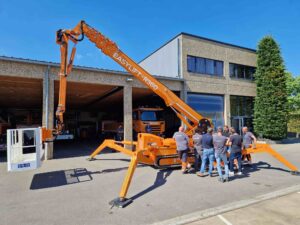
At the same time, great attention is paid to safety, with the introduction of elements that guarantee greater stability and control: independent and self-leveling stabilizers, variable configurations, rigorous quality controls, and thorough testing ensure high performance standards. Since 2018, membership in IPAF further confirms this commitment.
All this translates into a direct advantage for the end user, who can count on compact, lightweight, and versatile machines equipped with a wide range of accessories and simplified maintenance.
_____
Future perspectives
Safety and sustainability will continue to guide the development of new Easy Lift models in the future. In terms of green technology, the company plans to continue developing electric and hybrid versions, implementing the energy recovery system (EASY-HERS) already present on telescopic models on other models in the range, to reduce environmental impact while maintaining high performance.
The recent introduction of the RA31BA best represents this direction: the fully electric version of a best-selling model combines performance, compact design, and energy efficiency.
The company’s future also holds new developments in terms of height and operating capacity. The launch of the RA53, the “giant” of the range, demonstrates how Easy Lift is also pushing forward with more challenging models and well represents the company’s evolution in terms of functionality and power. After launching a medium-height model, the RA21, on the market this year, 2026 will be the year of a large model, with a working height of approximately 40 m.