Operating in sensitive environments means dealing with constraints different from those encountered on a traditional construction site. Hospitals, airports, shopping centers, museums, and public facilities require machines that can guarantee safety, quiet operation, low emissions, and maximum precision in movement.
In these contexts, the choice of aerial platform cannot be based solely on working height. Specific technical factors come into play, making tracked aerial platforms a particularly effective solution.
Working in sensitive environments: what are the critical issues?
Work carried out in closed or high-traffic environments must comply with well-defined technical requirements: minimizing emissions, reducing noise impact, allowing access to confined spaces, ensuring the continuity of current activities, and protecting delicate flooring.
In a hospital, for example, work on internal facades, windows, or technical systems must be carried out without interfering with patients and healthcare personnel. At an airport, maintenance work on false ceilings or lighting systems must coexist with constant passenger traffic.
Why choose a tracked aerial platform for indoor use
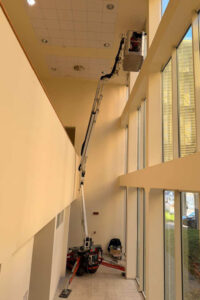
In sensitive environments, the issue of emissions is of central importance.
The ability to use the machine in electric mode allows it to operate in enclosed spaces without generating exhaust gases and with low noise levels.
At the same time, the alternative of a combustion engine allows the same platform to be used outdoors: a flexibility that is particularly appreciated on construction sites that require movement between indoor and outdoor areas.
In addition to power, structural aspects are also decisive when choosing a tracked aerial platform for sensitive environments:
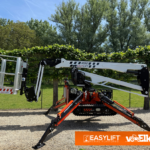
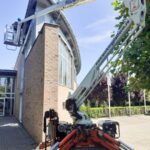
- Compactness: its small size allows it to pass through standard doors and areas with restrictions.
- Reduced ground pressure: tracks distribute the weight over a wider surface, reducing the risk of damaging delicate flooring, and in the non-marking version they prevent potential damage to the same surfaces.
- Stabilization: adjustable stabilization systems allow operation even in uneven spaces
- Ease of transport and positioning: mobility and low weight facilitate transport, access, and positioning.
The strategic role of rental in indoor environments
In addition to specialized companies that operate permanently in these contexts, rental companies are also gradually investing in compact and electrified platforms.
Maintenance and installation requirements in sensitive environments are often linked to temporary or scheduled interventions, for which rental is the most efficient solution: rental companies are therefore required to equip themselves with machines suitable for such contexts.
Our recent supplies to European rental companies confirm this trend.
Eurolev Vertical solution, a leading player in the French rental market, has recently expanded its fleet with two R160, one RA24, and one RA31. These models cover different height and outreach ranges and are designed to offer compactness, stability, and operational versatility, which are key features for working in sensitive environments and complex urban contexts.
At the same time, the Northern European market is also showing a growing interest in technical solutions suitable for indoor spaces. Drammen Lifte, one of Norway’s leading rental companies, has recently added an RA31HY to its fleet. This model combines compactness, stability, and high performance in terms of reach and load capacity, as well as a hybrid (HY) powertrain that combines a combustion engine, electric motor, and lithium battery.
These investments confirm the rental sector’s focus on machines capable of meeting increasingly specialized and demanding requirements.
Sensitive environments: a technical challenge
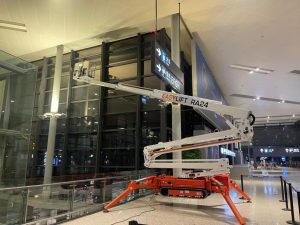
Evolving regulations, growing attention to sustainability, and the need to operate in increasingly urbanized contexts are redefining the criteria for choosing aerial platforms. It is no longer just a question of reaching certain heights, but of doing so while respecting the surrounding environment, safety, and operational continuity.
In this scenario, compact, tracked solutions suitable for sensitive, indoor environments represent a concrete response to the needs of users and rental companies.
Easy Lift aerial platforms are designed to meet these challenges, offering versatility and performance even in the most delicate contexts.